

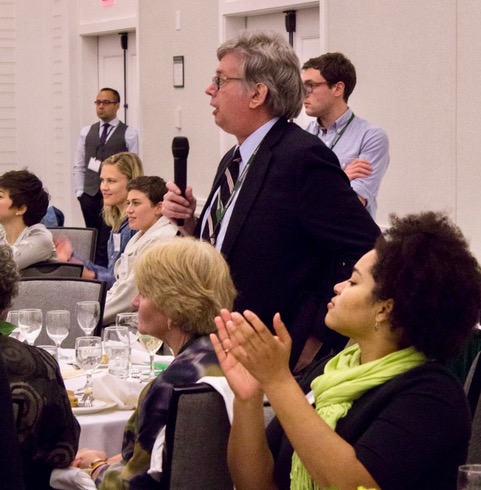
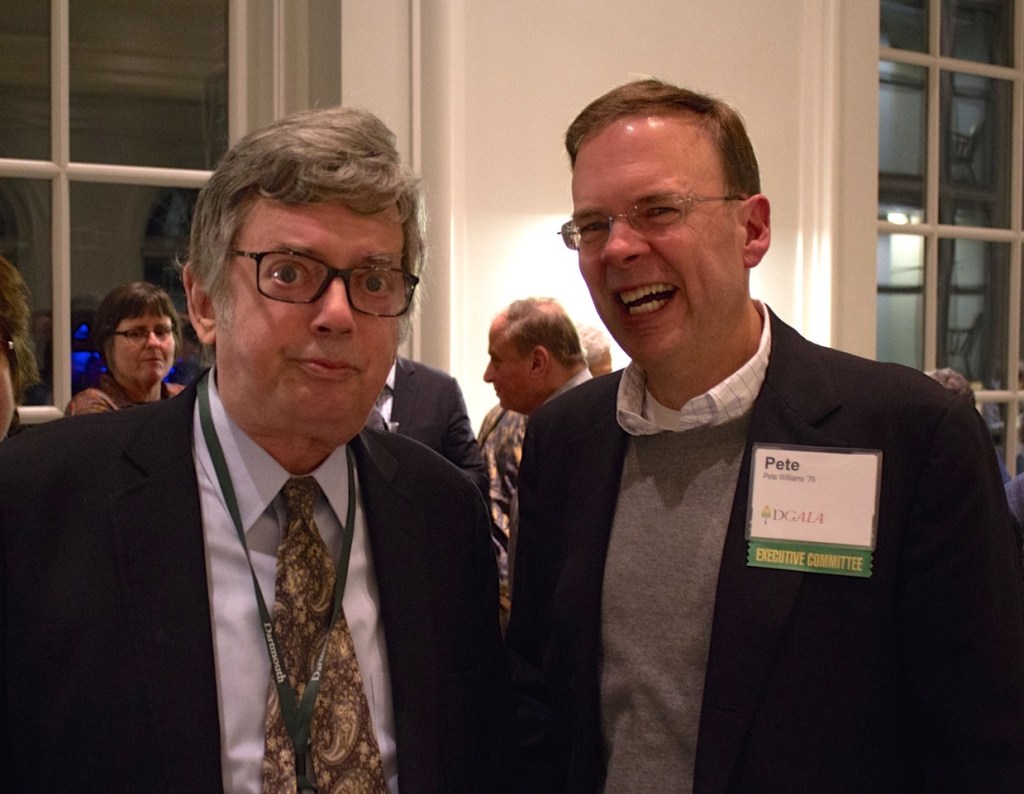
With deep regret we report the passing of Professor Peter Saccio in August of this year at age 83. DGALA honored Peter at our 20th anniversary all-class reunion on campus in 2004. In his remarks at the reunion, Saccio remembered his agonizing decision in 1984 whether to become advisor to Dartmouth’s fledgling LGBT student group. Peter ultimately said “yes,” thinking how he wished that some professor at his undergraduate college had done the same twenty years earlier. Peter remained a beloved advisor and supporter of Dartmouth’s LGBTQIA students and alums for the rest of his life.
Following Peter’s passing, DGALA reached out to our community for memories of Peter that they might share. Here are a few.
Eulogy at Peter’s Funeral by Colin Partridge ’72
To be honest, I am just as unprepared for today as I was for Peter’s unexpected Popquiz on Cymbeline when I hadn’t read it.
My name is Colin Partridge. I was Peter’s student in 1971 and 1972, a Choate resident where he was Master, and his friend for 54 yrs. When I met him in 1969, Peter was a young (if seemingly ancient to me) Dartmouth professor whose oversubscribed Shakespeare course I somehow got into. Peter believed in the power of education to transform lives, and he dedicated his life to that mission. Today, I will try to honor Peter by telling you about the effect he had on mine.
Even in my first day of Peter’s class, I was awed by his encyclopedic knowledge, his critical analyses, and the theatre he brought to Shakespeare. His passion, wit, and scholarship earned him every one of his many accolades. But in addition to his summa cum laude teaching, his office door and his professor’s heart were open to us all, as Henry V put it:
“Peter was but a man, as I am. The violet smelled to him as it doth to me. The element showed to him as it doth to me. All his senses had but human conditions.”
Peter was also there FOR us. Peter’s command of prose paved the way forward for me and hundreds of other students. I have never read the letter of recommendation he wrote. But his eloquence must have overcome the blank verse of my application. HIS letter got me accepted into medical school, my GPA did not.
His book “Shakespeare’s English Kings” guided me, hundreds of students, and thousands of theatre goers through the confusion of Henrys and Richards, and Warwicks and Norfolks in Shakespeare’s ten history plays. The book is still captivating, but Peter made Shakespeare’s kings and usurpers come live.
Astonishingly enough, he even tried to make me come alive as Spurio in Cyril Tourner’s ‘The REVENGER’S TRAGEDY.’ Peter was the faculty mentor for a senior’s honors thesis in directing. When I was far too vanilla as Spurio, the randy bastard son of the Duke, Peter gave me notes on how to act in this vivid and violent Jacobean revenge play: if I was going to seduce my stepmother, I couldn’t just SAY lustful lines, I had to play it DIRTY.
Peter was open, out, and honest decades before it was safe let alone acceptable. A brave leader of a band of brothers when most of us cowered — on stage or off, Peter fought for our silent minority with his words, his example and at least once with his fists. His believed deeply in justice, compassion, and the inherent dignity of every individual.
To be honest, Peter could turn three words into an hour-long gripping lecture. So just whatever could I say today?
An echo of Pistol from Henry IV
“Boy, bristle thy courage up; for Falstaff he is dead, And we must yearn therefore.”
Or perhaps, instead the Dartmouth motto:
Vox clamantis in deserto.
Peter WAS a voice crying in the wilderness, to me and to many other students, forceful and instructive. Peter was a teacher for all times. Just 3 months ago, Peter gave his final lecture – not in Birnham Wood but at the Woodlands — on the ghosts of Shakespeare.
Weeks ago, Peter confided that he was ready to die. I wanted to say something profound. [Imagine trying to come up with something new – let alone deep – to a Shakespearean scholar!] Instead, Peter commented on the paper I wrote on King Lear in 1972. I think I realize now why: Cordelia suffered a more enduring tragedy than Lear: she was left alone to grieve.
As a farewell to Peter today I turn to Hamlet (as Peter almost certainly would have done) for a line with which you will all agree: “He was a man, take him for all in all, I shall not look upon his like again.”
Eulogy at Peter’s Funeral by Jeff Hoover ’88
Good morning.
My name is Jeff Hoover, Dartmouth class of 88. It’s difficult for me to stand here and speak to you on this occasion for so many reasons. One is that in the back of my mind I suppose I always hoped Peter would be available to speak at my funeral or memorial service someday.
That would have guaranteed thoughtful and thought-provoking observations delivered with just the right mix of sorrow, consolation, wit and economy.
I don’t have to tell most of you that words were Peter’s life, and he used them like few others. I like to think he saw himself in competition with his idol Shakespeare, whom he elevated and demystified over a lifetime. In a profile in the Dartmouth Alumni Magazine in 2001, he said that he, quote, “fell in love with the power of words” at age 14, when reading the lines “let us sit upon the ground/And tell sad stories of the death of kings” from Richard the Second. In the same profile, he made a point of saying that “Shakespeare knew more words than God” as he used 30,000 different words compared with just 10,000 in the Bible (according to Peter).
I have little doubt that Peter could comfortably use all of those 30,000 words. Probably many of them were mentioned at least once in the audiotapes he began recording in the 1990s for The Great Courses. I highly recommend listening to some of these recorded lectures. You can find many clips online.
They are terrific. In them, he is passionate, relevant and quite funny at times. One of my favorite bits is from a talk on the Shakespeare authorship question. Peter says the following, in a tone mixing exasperation and confidence:
“When I tell people I teach Shakespeare for a living, I’m always certain to be asked, well, tell me, did he really write those plays? I shouldn’t complain. People with any kind of job have to get used to some idiot question or other. And it’s better to be a Shakespearean than a proctologist.”
Knowing his talents and curiosity about most things in life, I think Peter would have been an excellent proctologist if he’d chosen to go down that road. But I am one of many who are better off that he didn’t. As a scholar, teacher and mentor, Peter not only knew a lot of words, but he knew when to use them…and as crucially, when not to.
That was especially important to me, an erratic and confused young man trying to come to terms with being gay at Dartmouth in the mid to late 1980s. By then, Peter had become involved in supporting the gay and lesbian students’ group and was perhaps the most public gay person on campus. This was not easy for him and it was not a role he ever thought he’d play. Peter wasn’t a loud voice or a strident advocate by nature. But what he offered was just as valuable for any cause and exactly what I needed then — he was approachable, measured, calm, reassuring and discreet. In other words, a friend.
I first got up the courage to talk to him about the ‘bigger picture’, as I suppose you’d call it, during office hours when I was taking his Modern British drama course. (I wasn’t an English or drama major, but I’d made an uncharacteristically wise decision to take his course anyway after hearing so much praise from other students.)
He was immediately welcoming and it was such a relief for me to unburden or to simply feel less tense for a while. After that, we met frequently the rest of my time at Dartmouth. Then, and throughout the decades I knew him afterwards, he was a caring conversationalist no matter the circumstances. He listened, prodded when it was just right, and knew when a sympathetic ear with no judgement was needed.
It’s hard these days to overstate the value of such comfort and encouragement. We didn’t have social media to turn to, for better or worse, and the surging AIDS crisis was terrifying both for our potential physical health and our ability to be safe overall in a world where we were often blamed. His willingness to put himself out there, and for so long and for so many people, was a blessing with thousands of positive impacts that continue to ripple.
Peter’s support extended to my professional life as well. He and his partner Jim Steffenson helped me get my first job after college, working at a literary agency for 12,000 dollars a year. That was almost as dismal of a salary then as it would be now. But it was a leg up, and an entry into New York City and the world of adult work that I wouldn’t have had otherwise.
Peter remained a constant in my life for years after, especially when he regularly visited New York with or without Jim for the theater or other activities. In later years I was proud to be able to give back to him a little, especially after Jim died. Peter came to New Haven several times when my partner and I were living there, including for Thanksgiving once, and twice a year or so I tried to visit the Upper Valley and take him out to dinner at his beloved Hanover Inn or somewhere else with good cocktails, comfortable chairs and a slow pace.
The final few years were difficult for him as he faced repeated health challenges. Yet Peter remained Peter — frequently irascible and a voracious reader with opinions both sharp and generous of everything from the New York Times to LA crime thrillers by Michael Nava featuring a gay protagonist. Whenever I saw him during those difficult times the last few years, he asked about me and all that was happening in my life even as I was assuming it should be all about him.
I am honored and grateful to have had Peter Saccio in my life, and I miss him dearly.
Thank you.
Memories by Sam Abel-Palmer ’79
Where to begin? Like pretty much everyone in this group, my memories of Peter start with Shakespeare I. Of course, Peter was a captivating lecturer and brilliant scholar. As a Drama major, I enrolled in every course he offered. As wonderfully theatrical as his large Shakespeare lectures were –he loved an audience – it was in his smaller seminars that you really appreciated the depth of his knowledge. And the best part was that he invited the whole class to his home for dinner – a practice I dutifully imitated in my later teaching career.
Beyond the classroom, Peter was actively engaged with the Dartmouth Players, regularly taking on roles and supporting our work. I especially remember a production of the Harold Pinter Revue Sketches that a group of us pulled together at the start of my senior year to present for Freshman Week. Peter took on several roles on very short notice, and I can still see his hysterically funny and unnerving performance in “Interview” – which, in a true act of devotion to his art, he performed without his toupee (the one and only time I saw that).
As a teacher and mentor, Peter was fiercely loyal to his students, avidly following their post-Dartmouth paths. He could, of course, be quite demanding, even blunt. I recall sitting in his office in Sanborn discussing a draft of one of my papers, which he had thoroughly dissected. I remarked apologetically that I knew my writing style tended to be pedantic. Without missing a beat he replied, “Not pedantic – Pontifical.” It was a tough lesson, but one I still hear in my head when I’m writing.
Happily, my memories of Peter did not end with graduation in 1979. In 1990, I returned to Hanover to join the Drama faculty. By then, Peter’s life partner Jim Steffenson had also come to Dartmouth and all three of us were (finally) out of the closet. Peter once again became a teacher and a mentor. He graciously ceded to me his role as faculty advisor to the gay student group (DAGLO was the iteration at the time, I recall), and he supported me as I eased my way into those first rounds of jousting with the administration on domestic partnership benefits and official student group recognition.
Even more joyously, Jim and Peter brought me into their community. I was admitted into the exclusive club of invitees to their private dinner parties, which were filled with wonderful food and very heady conversations. I particularly treasured the late night conversations with Peter, Jim, Bill Cook and Charles Stinson about the closeted history of Dartmouth faculty in the 60’s and 70’s, things my younger and very naive self certainly had not seen.
When I met Craig in 1992, Peter and Jim warmly welcomed him into the fold. When Craig and I had our commitment ceremony in 1994, at the First Congregational Church in Thetford, Vermont (the church where Craig’s parents were married), we were deeply honored that Peter and Jim agreed to grace our wedding ceremony with a tag-team reading of Shakespeare’s Sonnet 116 (“Let me not to the marriage of true minds . . . “). It was, to say the least, a stunning moment.
After I left Dartmouth again in 1997, we were happily able to keep in touch with Peter. I came back for Jim’s memorial (Peter never really got over losing him). We saw him a number of other times back in Hanover, and he came up to see us in Vermont to tour the lilacs–his favorite–at the Shelburne Museum. The last time we saw him was a little before the pandemic, when we were visiting Hanover and ran into him reading in a corner of the upper floor of the Dartmouth Bookstore (shortly before it closed). His body seemed tired, but his mind was as sharp as ever. And that is ultimately what I will remember about Peter – his grand, theatrical, generous, wickedly funny and deeply emotional mind and heart.
Sam Abel-Palmer ‘79
Memories by Amelia Craig Cramer ’82
When I was a student at Dartmouth, Professor Peter Saccio inspired me to deeply love Shakespeare. His assignments included not just reading the words of the plays on the page, but listening to them on recordings, reading how commentators understood and interpreted them, and then expressing my own interpretations through written essays and even acting out scenes. I spent hours in an old wingback chair in the Sanborn House Library, a heavy volume of Shakespeare’s collected works balanced on a board set across the arms of the chair, more hours in the basement of Baker Library listening to records, and yet more hours on the steps of Dartmouth Hall happily immersed in playing the role of Viola from Twelfth Night.
But what is most deeply etched in my memory of my undergraduate education at Dartmouth is Professor Saccio lecturing from the front of a large auditorium classroom, enrapturing me with his brilliance and his passion. I will forever be able to recall at will his unique voice, his theatric mannerisms, the beaming expression on his face, and his expansive gestures as he spoke about the nuances of language, the layers of meaning, the exquisite storytelling of Shakespeare.
Professor Saccio is the reason I majored in English, rather than biology. He is the reason I quit the tennis team and made academic learning my priority in college – because the practice time for tennis conflicted with the time of his class. And Professor Saccio is the reason my adult daughter, an actor, cherishes that old, worn volume of Shakespeare’s collected works that I passed on to her, knowing it was one of my most prized possessions.
Years after I graduated, when I was executive director of GLAD in Boston and had time to visit Dartmouth on a regular basis, Peter Saccio became my colleague and friend. He was the Dartmouth faculty member who led efforts to support LGBT students at the college, through the Carpenter Foundation and DGALA with which I was actively involved for several years. I will never forget talking with Peter over lunch at the Hanover Inn, discussing how best to ensure that the abuses we had endured as openly gay and lesbian members of the Dartmouth community would not be inflicted upon others, how to support students from our community who were struggling. Peter’s courage, in being out of the closet at a time when it was still dangerous, and even more impressively being an activist in support of LGBT students at that time, was inspiring.
Peter’s memory will live on and be cherished not only by me, but also by his fellow scholars of Shakespeare, his Dartmouth faculty colleagues, all the students he taught, as well as all of Dartmouth’s LGBTQIA+ community.

You must be logged in to post a comment.